Photo: Hernán Santarelli / Pexels (photo page on Pexels, opens in a new tab)
Saturday's rammed, the phone's ringing off the hook and you're turning people away. Tuesday, the team outnumbers the guests by teatime. Sound familiar? Almost every venue has the same shape to its week. The trick isn't to wish it away. It's to read the diary like a sales report and do something about the gaps.
Your week, in one picture
Here's an imaginary 70-seat restaurant that can do two sittings a night: a capacity of about 140 covers. This is what a normal week looks like.
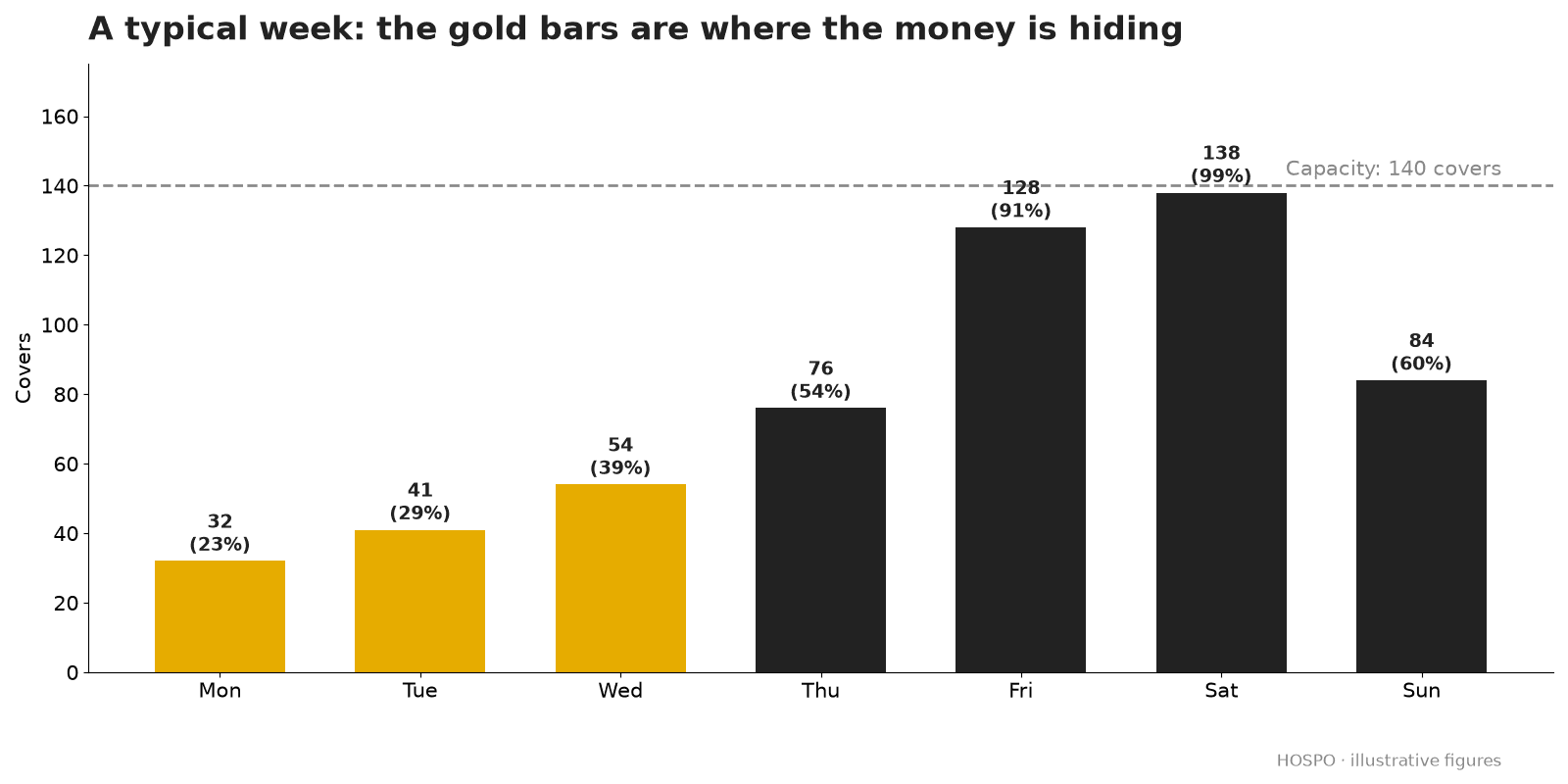
Add it up: 32 + 41 + 54 + 76 + 128 + 138 + 84 = 553 covers out of a possible 7 × 140 = 980. That's 553 ÷ 980 = 56.4% of capacity used across the week.
Friday and Saturday are nearly full. You can't grow much there. The growth is Monday to Thursday, where you're using between 23% and 54% of the room.
You can't sell a Saturday twice. You can sell a Tuesday properly.
What one quiet night is worth
Let's say you add 20 covers on a Tuesday. Average spend is £38 a head (net of VAT), and your GP is around 70%.
- Extra sales: 20 × £38 = £760 a week
- Extra gross profit: £760 × 0.70 = £532 a week
- Over 50 trading weeks: £532 × 50 = £26,600 of gross profit
And because you're already open, the heating's on and the chef's already in, a fair chunk of that drops through to the bottom line. Quiet nights are usually where the cheapest growth is hiding.
Protect the peaks first
Before chasing Tuesdays, make sure you're not leaking money on the busy nights.
- Set your turns properly. If tables are booked for two hours but sitting for three, your second sitting is a fiction. Check real dwell times in your booking system and set slot lengths to match.
- Pace the kitchen. Cap the covers per 15-minute slot so the kitchen isn't hit with 40 mains at once. Slower tickets mean longer sittings, which means fewer covers.
- Reconfirm big tables. A courtesy call or message the day before for larger groups gives people the chance to release a table you can resell.
- Have clear terms for deposits or card details, if you use them for big tables or peak nights. Tell guests the terms clearly when they book, not after.
- Keep a waitlist. When Saturday's full, take names. Cancellations happen, and a waitlist turns them back into covers.
Then fill the gaps
Some ideas that work on quiet nights, without slashing prices:
- Give people a reason. A set menu, a regular supper club, a chef's table, a wine flight, a pie-and-pint night. Something worth a mid-week trip that you can talk about.
- Talk to your regulars first. The people who already love you are the easiest to bring back on a Wednesday. A short email or message to your list beats an ad.
- Local groups and businesses. Book clubs, running clubs, office teams, local societies. A Tuesday is perfect for a group that wants the room to themselves.
- Shift the opening hours, not just the offer. If Monday dinner never works, maybe it's a lunch day, or a closed day. Make sure your Google hours and website match what you actually do.
- Bring the big tables to the quiet nights. When someone calls for a 14-top on a Saturday, offer the Thursday with something extra. Many will take it.
A word on discounts
Money-off deals do fill seats, but be careful. A blanket 50% off food can teach people that your normal price is the wrong one, and it can attract guests who only come when there's a deal. If you discount, keep it targeted (one night, one menu, one group), keep an eye on GP, and measure whether those guests come back at full price. Often an extra (a free dessert with the set menu, corkage-free Tuesdays) does the same job without cheapening the brand.
Keep the diary clean
A messy diary hides opportunities and causes problems on the night. A few house rules:
- One system. No bookings on Post-its or in someone's DMs. Everything goes in the diary.
- Notes that help service. Occasions, regulars' preferences, accessibility needs, high chairs. Short and useful.
- Allergies flagged but confirmed on the night. Booking notes are a heads-up, not a guarantee. Food Standards Agency best practice is to talk through allergen needs with each person on the day, even if a group has pre-ordered.
- Track no-shows and walk-ins. You can't fix what you don't measure.
A script for the phone
When Saturday's full, don't just say no. Try:
"I'm really sorry, Saturday's fully booked. I can pop you on our waitlist, and we'll call if anything comes up. Or if you're flexible, we've got lovely tables on Thursday, and that's when we run our supper menu."
Friendly, helpful, and it turns a "no" into two chances of a "yes".
Watch
Inside the mind behind The Ivy, Arlington & Simpson's in the Strand | Jeremy King OBE
Winning with Ian Rosenblatt OBE on YouTube (opens in a new tab) ·
Why watch: Jeremy King on regulars, the door and building a dining room one booking at a time.