
Photo: Mikhail Nilov / Pexels (photo page on Pexels, opens in a new tab)
- Good for
- Running the venue
The monthly P&L lands in your inbox. It's three pages of numbers, half of them in brackets, and someone wants to "go through it" on Thursday. Deep breath. A profit and loss account is just the story of the month told in pounds. Once you know the order it's told in, it gets a lot less scary.
The shape of every P&L
Whatever software or accountant you use, a hospitality P&L almost always runs in this order:
- Sales (net of VAT), usually split into food, drink and sometimes other
- Cost of sales: what you paid for the food and drink you sold
- Gross profit: sales minus cost of sales
- Labour: wages, salaries, employer's National Insurance, pension contributions, holiday pay
- Overheads: rent, business rates, utilities, repairs, marketing, card fees, insurance, software, cleaning and the rest
- Operating profit: what's left before interest, tax, depreciation and so on (often called EBITDA)
Everything above the gross profit line is mostly about what you buy and how you sell it. Everything below it is mostly about how you run the place.
A worked month
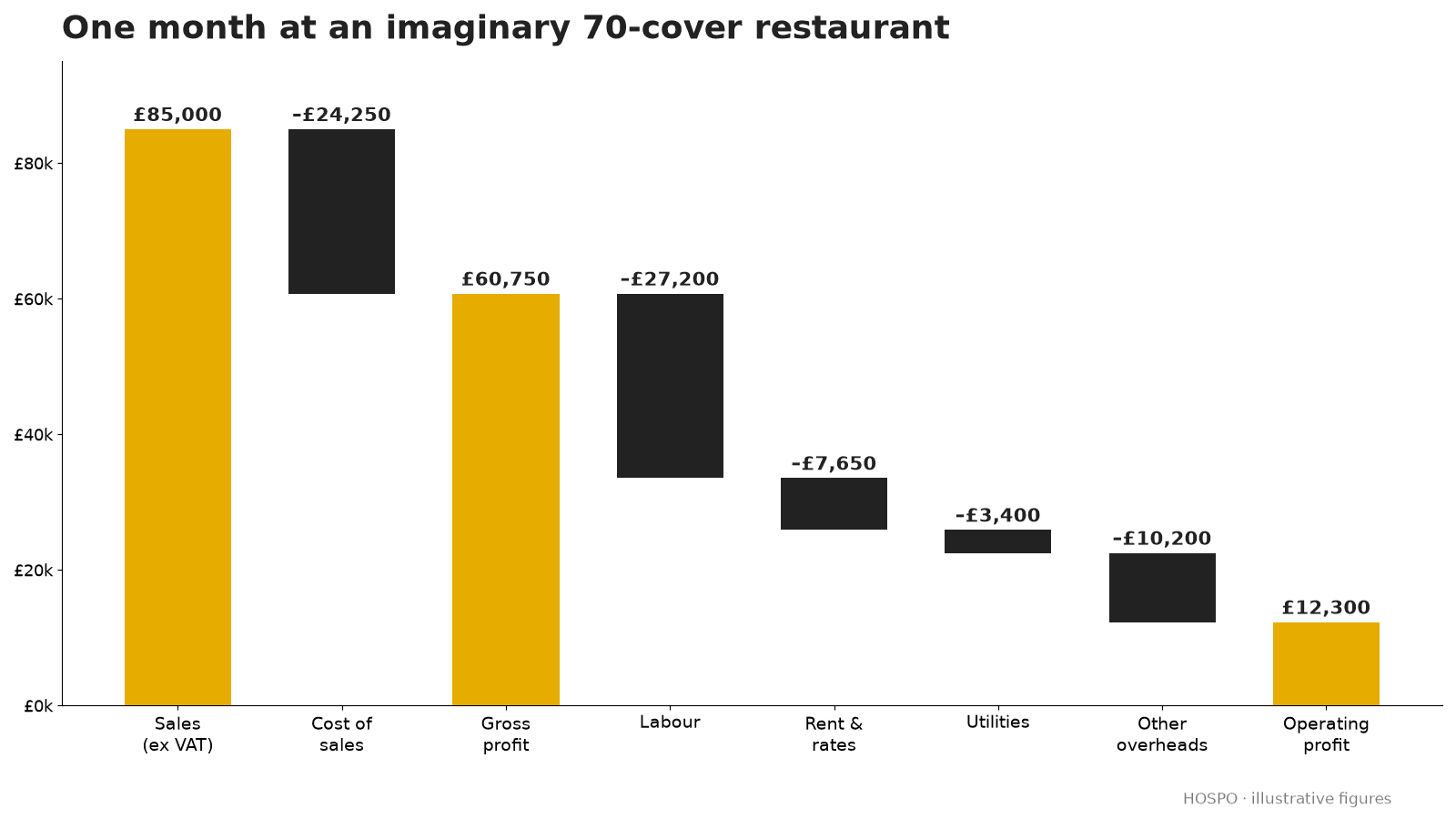
Here's an imaginary 70-cover neighbourhood restaurant. The numbers are illustrative, not a benchmark, but they add up.
Sales (net of VAT)
- Food: £60,000
- Drink: £25,000
- Total sales: £85,000
Cost of sales
- Food at 30% of food sales: £60,000 × 0.30 = £18,000
- Drink at 25% of drink sales: £25,000 × 0.25 = £6,250
- Total cost of sales: £24,250
Gross profit
- £85,000 − £24,250 = £60,750
- £60,750 ÷ £85,000 = 71.5% (to one decimal place)
Labour (all-in, including employer costs)
- £27,200, which is £27,200 ÷ £85,000 = 32% of sales
Overheads
- Rent and rates: £7,650 (9% of sales)
- Utilities: £3,400 (4%)
- Other overheads: £10,200 (12%)
- Total overheads: £21,250
Operating profit
- £60,750 − £27,200 − £21,250 = £12,300
- £12,300 ÷ £85,000 = 14.5% (to one decimal place)
Read it as percentages, then as pounds
Percentages let you compare this month with last month, even when sales move about. Pounds tell you what actually happened in the bank. You need both.
A useful one to watch is prime cost: cost of sales plus labour. Here that's £24,250 + £27,200 = £51,450, or £51,450 ÷ £85,000 = 60.5% of sales. These are the two biggest costs you control week to week, so they're where a GM or head chef can make the biggest difference.
A P&L is just the story of the month, told in pounds.
Why a quiet month hurts so much
This is the bit that catches people out. Some costs move with sales (food and drink). Some barely move at all in the short term (rent, rates, insurance, most salaries). So when sales drop, profit drops much faster.
Same restaurant, but sales fall 10% to £76,500, with the same food and drink mix:
- Gross profit falls 10% too: £60,750 × 0.9 = £54,675
- Labour stays at £27,200 because the rota didn't change (now 35.6% of sales)
- Overheads stay at £21,250
- Operating profit: £54,675 − £27,200 − £21,250 = £6,225
A 10% dip in sales has roughly halved the profit, from £12,300 to £6,225. That's why good operators watch the forecast and adjust rotas early, rather than waiting for the P&L to tell them a month late.
Labour: the line with people in it
Labour is usually the biggest single cost after (or sometimes ahead of) cost of sales. When you look at it:
- Make sure it's all-in. Employer's National Insurance, pension contributions and holiday pay are real costs. If they're sitting somewhere else on the P&L, your labour % looks better than it is.
- Split it if you can. Kitchen, front of house and management, so you can see where the hours go.
- Plan for rate changes. Minimum wage rates change every April, and employer's NI thresholds and rates can change at Budgets. Check current rates on GOV.UK and build them into next year's numbers before they arrive.
- Remember tips aren't yours. In Great Britain, under the Employment (Allocation of Tips) Act 2023, qualifying tips and service charges must be passed to workers without deductions, so they can't be used to prop up your labour line.
Five questions to ask every month
Watch out for these
- Stock take timing. If the stock take was done on a different day, or skipped, GP% can swing wildly. A "great" month followed by a "terrible" one is often just stock moving between them.
- Accruals. A big bill that hasn't been accounted for yet makes this month look better and next month worse.
- VAT in the wrong place. Sales should be net of VAT. If your till report and P&L don't match, start there.
- Card fees and delivery commission. Often hidden in "other". They can be big. Pull them out so you can see them.
Watch
A Day at Fallow, London's Hottest Restaurant | On The Line | Bon Appétit
Bon Appétit on YouTube (opens in a new tab) ·
Why watch: every line on a P&L is people, produce and kit. A day at Fallow shows those lines in motion.