
Photo: Cafés To Work From / Pexels (photo page on Pexels, opens in a new tab)
- Good for
- Running the venue
Before most guests walk through your door, they've already visited you online. They've seen your Google listing, checked your hours, scrolled your photos, read a few reviews and maybe looked at the menu on a delivery app. That's your real front door now. Here's how to make sure it's open, tidy and not quietly costing you money.
Start with your Google Business Profile
For a lot of people, the first thing they see when they search for you is your Google Business Profile, the box with your hours, map pin, photos and reviews. It's free, and it's worth getting right.
Reviews: reply, don't buy
Reply to reviews like a good host. Thank people properly, and when someone's had a bad time, acknowledge it, don't argue, and offer to put it right offline.
What you must not do is fake them. Under the Digital Markets, Competition and Consumers Act 2024, submitting or commissioning fake reviews, or reviews that hide an incentive, is banned outright. The Competition and Markets Authority has published guidance on it. Google's own policies are stricter still about offering anything in return for reviews. The safe rule: ask happy guests to leave a review if they'd like to, and don't offer anything in exchange.
Ask happy guests to leave a review if they'd like to. Never offer anything in exchange.
Your website: four jobs, done well
Your website doesn't need to be fancy. It needs to do four jobs, quickly, on a phone:
- Tell people where and when. Address, map, hours, phone number, on the first screen.
- Show the menu. As a web page, not just a PDF that's hard to read on a phone. Keep it up to date.
- Let them book or order. A clear button, as few clicks as possible.
- Make allergen info easy to find. Food Standards Agency best practice for online ordering is to have allergen information available before the order is placed, ideally no more than one click from the menu, and again in writing when the food arrives.
If you're in Wales and sell takeaway with a menu that lets people order without visiting, you're legally required to include a bilingual statement directing customers to the food hygiene ratings website. Check the FSA guidance.
Booking platforms
Online booking systems and restaurant discovery platforms can bring in new guests and make the diary far easier to run. Before signing up, ask:
- What's the cost: monthly fee, per-cover fee, or both? Is there a difference between bookings made through your own website and through the platform's app?
- Who owns the guest data, and can you market to those guests? (Only with their permission.)
- How easy is it to leave, and can you take your data with you?
Then check it quarterly. If most bookings coming "via the platform" are actually your regulars who'd have booked direct anyway, you're paying for people you already had.
Delivery apps: do the maths first
Delivery platforms can add real sales, especially on quiet nights. They can also add very busy, very unprofitable ones. Here's a single £30 order, with illustrative numbers. Commission rates vary widely by platform and deal, so use the figures in your own contract.
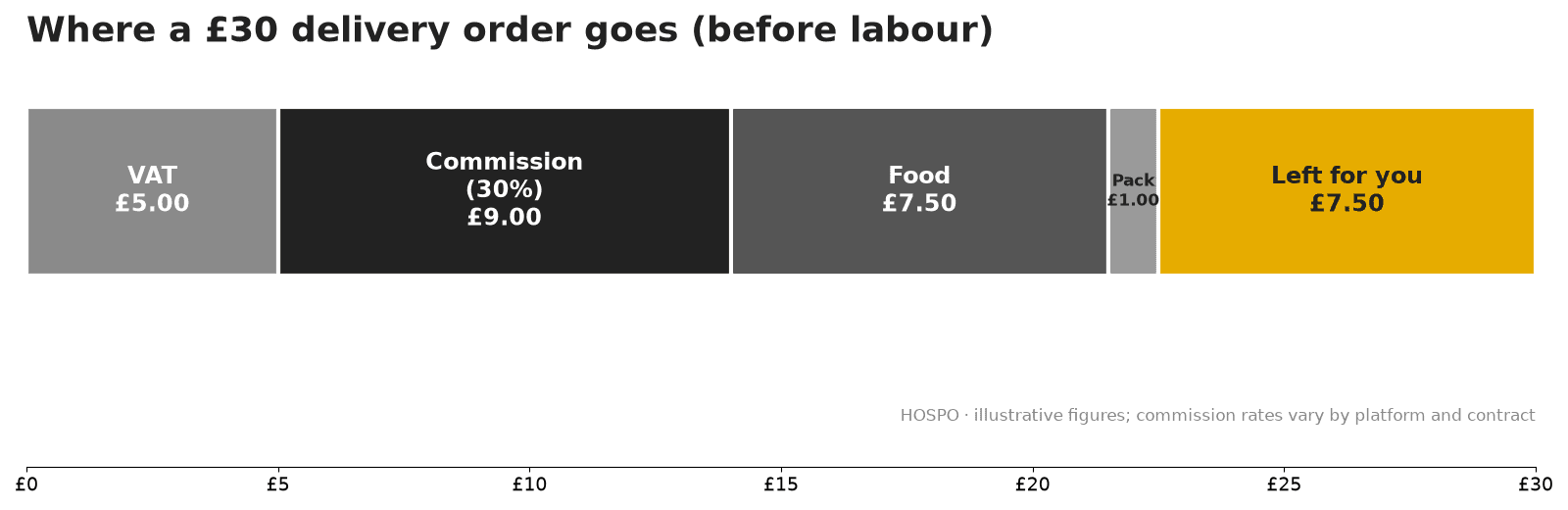
- Order value: £30.00 (inc VAT)
- For this illustration, assume the whole order is standard-rated at 20% VAT. VAT: £30.00 − (£30.00 ÷ 1.2) = £5.00, leaving £25.00 net
- Commission at an illustrative 30% of the order value: £30.00 × 0.30 = £9.00
- Food at 30% of net sales: £25.00 × 0.30 = £7.50
- Packaging: £1.00
- Left for you: £25.00 − £9.00 − £7.50 − £1.00 = £7.50, before labour and overheads
The same £30 spent in the dining room would leave £25.00 − £7.50 = £17.50 before labour. For simplicity we've ignored VAT on the commission itself, which your accountant will want to account for.
Some operators set delivery menu prices higher to cover these costs. With an illustrative 10% uplift, the same order becomes £33.00: VAT £5.50, net £27.50, commission £9.90, food at 30% of net sales £8.25, packaging £1.00, leaving £27.50 − £9.90 − £8.25 − £1.00 = £8.35.
Questions to ask before you switch on delivery
- Does the kitchen have the capacity, or will dine-in tickets suffer on a Friday?
- Which dishes travel well? A smaller delivery menu is often better.
- Is the allergen information on the platform complete and up to date, and does the order arrive with allergen information in writing?
- Are you tracking delivery as its own line, so you can see whether it actually makes money?
Sources
- Google Business Profile Help: guidelines for representing your business on Google (opens in a new tab)
- GOV.UK (CMA): Online consumer reviews / fake reviews guidance (opens in a new tab)
- legislation.gov.uk: Digital Markets, Competition and Consumers Act 2024, Schedule 20 para 13 (fake and concealed-incentive reviews) (opens in a new tab)
- Food Standards Agency: Allergen information for non-prepacked foods, best practice (distance selling) (opens in a new tab)
- Food Standards Agency: FHRS guidance for businesses (Wales takeaway menu statement) (opens in a new tab)
- GOV.UK: VAT rates (opens in a new tab)